In science, we often speak about good and bad explanations (in D. Deutsch terms), our good/bad theories about how the world works. Good explanations are theories that are “hard to vary”—they always hold true. For example, why we have the change of seasons, general relativity, or how to calculate the velocity of a body when you know the distance traveled and time. Some of these are far-reaching, they apply even in distant galaxies we may never see. Conversely, we also speak about “bad explanations.” These are theories that are “easy to vary.” They do not clearly explain why something is happening or guarantee a predictable outcome when applied, they do not always hold true. When there are many different opinions on how something works, and they do not consistently apply or hold true, we consider those bad explanations. For example, people historically used myths to explain the seasons. These explanations were easily varied; many cultures simply invented their own unique characters and stories to describe the same natural cycles.
When it comes to entrepreneurship and making a startup widely successful, it seems we do not have so many “good explanations.” There is no unified theory that, when used, will always guarantee the success of a company. The nature of business and building something out of nothing is so complex, depend case-by-case, and so unique that it is hard to find a unified theory, that when used will guaranty successful outcome. We rarely have one good explanation how to make a startup widely successful.
I couldn’t help but recollect what P. Thiel said regarding startups, paraphrasing here.. the opening of Anna Karenina start with: “All happy families are alike; each unhappy family is unhappy in its own way.” Thiel argues that the opposite is true for startups: “Each happy startup is happy in its own way, but all sad startups are alike.” It seems that every successful company finds its on unique way towards a great success, ways to solve a unique challenges and how to build a ‘happy company’. This suggests that while we lack a unified theory for success, we do have good explanations for what makes a startup miserable or unsuccessful (maybe one obvious example if you don’t have customers, you will cease to exist). Perhaps by studying more of what makes startups unsuccessful, we can reach a level of “good explanation” regarding business. We often learn more from failures and what didn’t work than from the widely successful startup stories we all hear and how they achieved success (most of the time, success is unique to them). In engineering at least, we often learn more from failure than success (my most valuable lessons were the ones about failure, what didn’t work, and why). I believe we all know this intuitively.
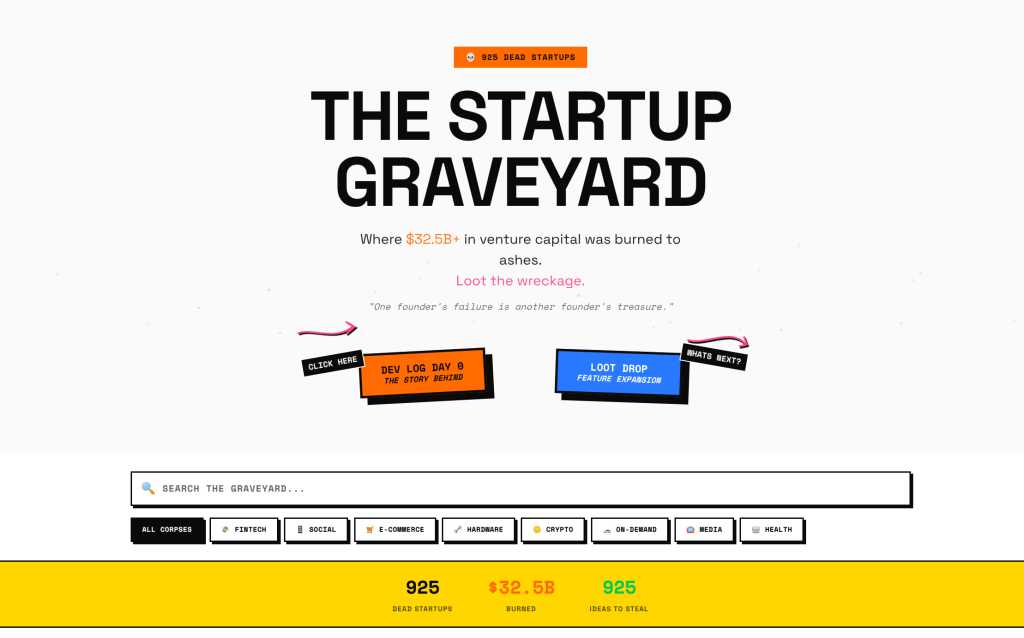
One great project I found collected a database and analyzed various startups that failed. It frames these business failures not just as cautionary tales, but as opportunities for new founders to learn from and potentially “loot” ideas to rebuild better: https://www.loot-drop.io/
Very cool project. I hope we all learn from these cases and reach some good explanations for how to make a startup successful.
 Andrija Milojevic
Leave a comment